

There Aren’t Enough Smart People
A conversation with Eugene Healey about brand, attention, and why the bottom 90% of strategists should probably be a little worried.

Behind the Brand is written by the team over at Defiant. We bring together big agency brains with Effie winning writers, comedians & creators with millions of followers. We help brands define razor-sharp strategy & develop creative ideas that win the war on attention.
Learn more about us HERE
I went into this conversation braced for the usual creator-economy gospel. The “build your personal brand,” “post daily,” “here’s my content engine” stuff that makes my skin crawl a little.
I got none of it.
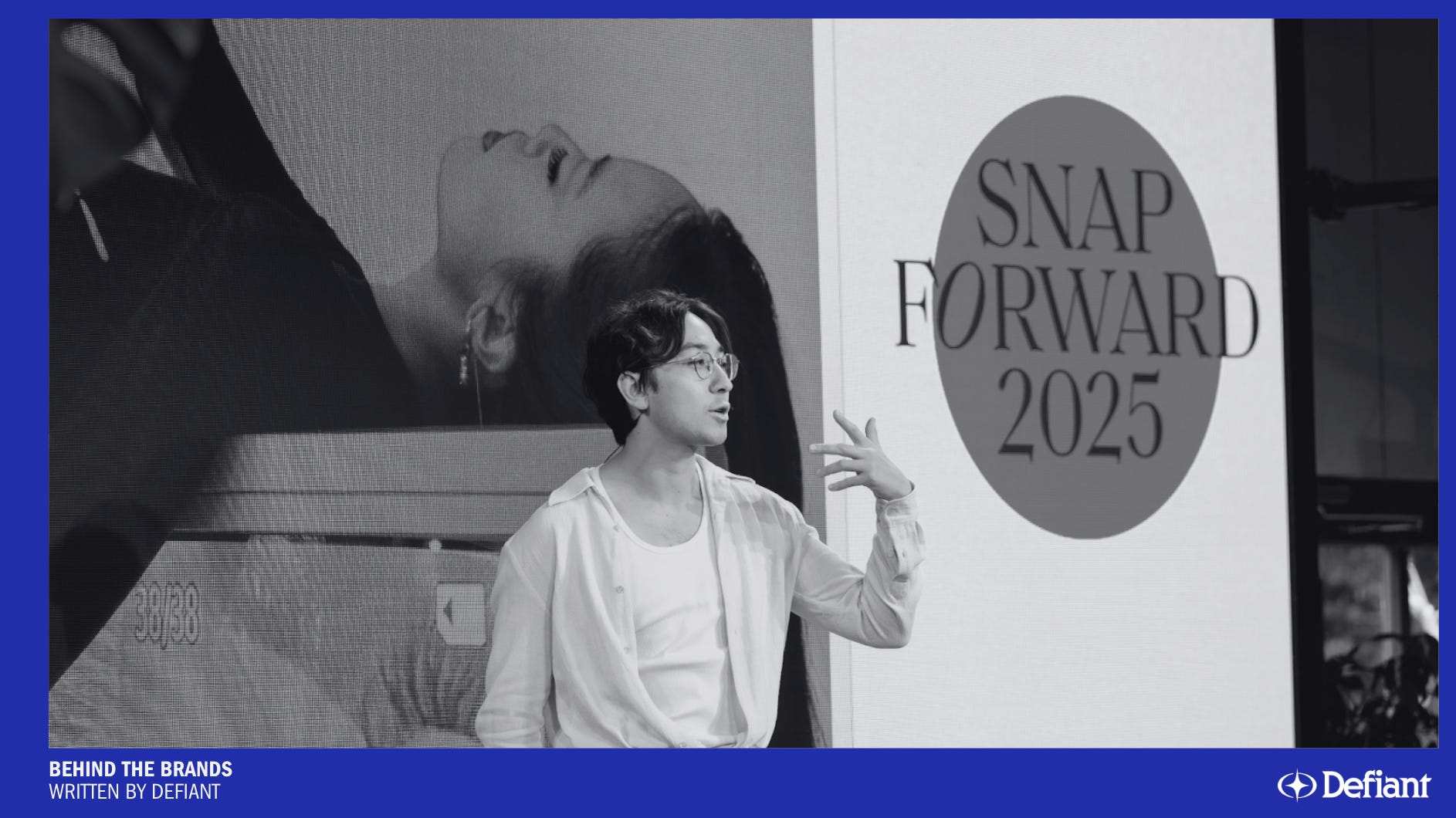
What I got instead was one of the more clear-eyed conversations I’ve had about what’s actually happening to our industry, from a man who has built one of the sharpest strategic voices on the internet in under two years. Eugene Healey is a classically trained strategist and former lecturer who started posting his thinking online because, in his words, strategy is the one thing you can’t put in a portfolio. So he built a living one instead. And in his own words, it worked rather better than planned. The CEO of Microsoft AI has stopped him at Cannes. James Blake has reposted him. People recognise him at music festivals, which, if you’ve ever met a strategist, you’ll know is not the natural order of things.
But the interesting part isn’t the reach. It’s how he thinks. Here are the four ideas I haven’t been able to put down since.
1. Hire smarter people
The first thing I asked Eugene was what he’d do differently if he started again. His answer surprised me: almost nothing except he’d have built his team months earlier. He brought in a social media strategist, a manager and a researcher last September. He wishes he’d done it in February. That extra resource is what let him scale the platform in several directions at once, and freed him up to start other businesses on top of it.
For most of us running small shops, that instinct cuts against everything in our gut. Hiring feels like a cost you justify after the work arrives, not before. My own struggle with delegation cost me years, I tried to do everything myself, convinced that handing things off was either an indulgence or an admission that I couldn’t cope. Eugene’s framing was the antidote to this. The catastrophising voice that says it could all dry up tomorrow, don’t commit to anyone is, he reckons, just wrong:
“You can afford to put some other mouths on the table. It’s going to be worth feeding them.” Eugene Healey
And the people he’s fed aren’t juniors fetching coffee. His mum apparently asked why he’d hire anyone at all when he could keep the money himself. But the value isn’t cheap labour, it’s a second and third sharp perspective. They challenge his scripts, push back when a line is too dense, and own the genuinely hard craft of working out how to visualise an abstract idea in a way that travels.
Which leads to the deeper point, and the bit I keep returning to in an age where everyone’s quietly terrified that AI is coming for their job. The bottleneck has never been tools or output. It’s judgement. And there simply isn’t enough good judgement going around:
“Bigger and bigger companies are working with smaller and smaller consultancies. It turns out they just want the very consciously subjective advice of someone specific that they trust.” Eugene Healey
2. Mass, reached through the niches
If there’s one phrase from this conversation I’d tattoo on the inside of every CMO’s eyelids, it’s this one:
“Whilst mass reach still matters, it’s changed. Its mass through the niches, rather than the other way around” Eugene Healey
This is his “brand as mosaic” idea, and it’s where Eugene and I are in violent agreement. The mass medium isn’t being replaced by another mass medium. It’s being replaced by a thousand fragments. Tom Roach’s “lots of littles,” Eugene’s mosaic and the brands winning right now are the ones building for that reality rather than mourning the death of the thirty-second TV spot.
What’s interesting, however, is that even in this splintered world, Eugene still thinks in the old buckets; awareness, consideration, conversion. The funnel isn’t linear and never really was, but it’s still the most useful bad model we’ve got. He maps his content to exactly those roles: broad “come into the tent” content at the top, deeper mechanism-led pieces in the middle, the occasional direct ask at the bottom. The discipline is constant:
“I’m always thinking about what’s the maximum number of people that could be interested in a message, and what’s the right balance between depth and accessibility.” Eugene Healey
3. Trends are a Trojan horse, not the prize
I’ll admit a slightly embarrassing personal tactic here: I’ve learned that catching a trending topic on the rise tends to win favour with the algorithm. I wrote something about Stranger Things while Stranger Things was out, and it flew. So I assumed Eugene, plugged in as he is, must be hunting trends constantly.
He isn’t. In fact he’s almost allergic to it:
“I used to believe it was really important to be first. Now I believe it’s much more important to deliver a really strong, coherent take.” Eugene Healey
What he does instead is far smarter, and it’s the thing I’ll likely steal. He uses a familiar trend as the entry point to a much deeper idea, the recognisable thing the audience already understands, which lets him smuggle in something dense without losing them.
“I like to use trending topics to explain something that is a deeper trend. That’s the way of scaffolding in a complex concept.” Eugene Healey
His example: a video on “looksmaxxing,” posted weeks after the New York Times had already covered it, used as a way into Baudrillard and the idea of the body as the final frontier of capital. A genuinely difficult concept, compressed into two minutes, riding on the back of a trend everyone already had context for. A million views. The trend was the vehicle. The idea was the cargo.
4. The percentile reckoning
This is the one that’ll sting, and Eugene didn’t soften it:
“The bottom 90% of this industry are about to suffer. Every percent you get above the 90th percentile correlates to exponential gains.” Eugene Healey
His maths: the 95th-percentile strategist is a “$500,000 a year role” ad the 99th is “$1M a year role”. And the brutal truth is the climb from 90% to 95% to 99% is brutally hard, which is precisely why it pays. The commodity middle; the people doing competent, automatable, indistinguishable work… is the bit most exposed.
But the escape route isn’t just being clever. Plenty of strategists are smarter than me and going nowhere, because they make the classic error: needing the room to know they’re the smartest person in it, then getting frustrated when nobody follows. The easy part of this job is the thinking. The hard part is the persuading. As Eugene put it:
“Good thinking presented well always wins out in the end.” Eugene Healey
Eugene’s new course
The New Fundamentals of Brand is a course for marketers navigating today’s fragmented media, tech, and cultural environment.
Most marketing education was built for a stable world where brands moved glacially through segmentation, targeting, positioning, comms. Those fundamentals still hold. The environment doesn’t.
Brand building is now non-linear, always-on, and built bottom-up through influencers, partnerships, and collaborations. You can’t control that output tightly anymore — you have to orchestrate it. This course teaches you how.
You can click here to find out more and be notified about future cohorts:
https://www.eugenehealey.com/thenewfundamentals
In summary
In summary here are the four ideas Eugene and i covered.
1. Hire smart: Hire help sooner than feels comfortable, and trust that a specific, proven brain is what clients are really buying.
2. Mass through the niches. The mosaic has replaced the mass medium. Build for the fragments, but keep running the full awareness/ consideration/ conversion system rather than picking one.
3. Trends are a Trojan horse. Don’t chase being first. Use familiar trends as the entry point for deeper ideas, and win on the strength of your take rather than your speed.
4. The percentile reckoning. The commodity middle is in trouble; the gains above the 90th percentile are exponential. But great thinking only counts if it’s packaged to persuade.
The thread running through all of it: in a world drowning in cheap output, the scarce thing is a sharp, specific point of view, delivered well, by someone you trust.
Behind the Brand is written by the team over at Defiant. We bring together big agency brains with Effie winning writers, comedians & creators with millions of followers. We help brands define razor-sharp strategy & develop creative ideas that win the war on attention.
Learn more about us HERE
What first took me back when I joined my company, was the sharp intellect of the team - especially juniors. I’m always careful in interviews to hire the people who are the best problem solvers and thinkers; you don’t need professional refinement at level 1, just the drive and curiosity.
Thanks for this! As a solopreneur it is important to remember to pay people to help you even if you could do it yourself.