


Behind the Brand is written by the team over at Defiant. We bring together big agency brains with Effie winning writers, comedians & creators with millions of followers. We help brands define razor-sharp strategy & develop creative ideas that win the war on attention.
Learn more about us HERE
I keep coming back to a strange fact: 450 million people open Snapchat every single day, and yet nobody thinks of it as a winner. Not the press, not advertisers, not even the teenagers who built their whole social lives on it a decade ago. It loses money. It loses relevance. And it did both while inventing nearly every format that now defines social media.
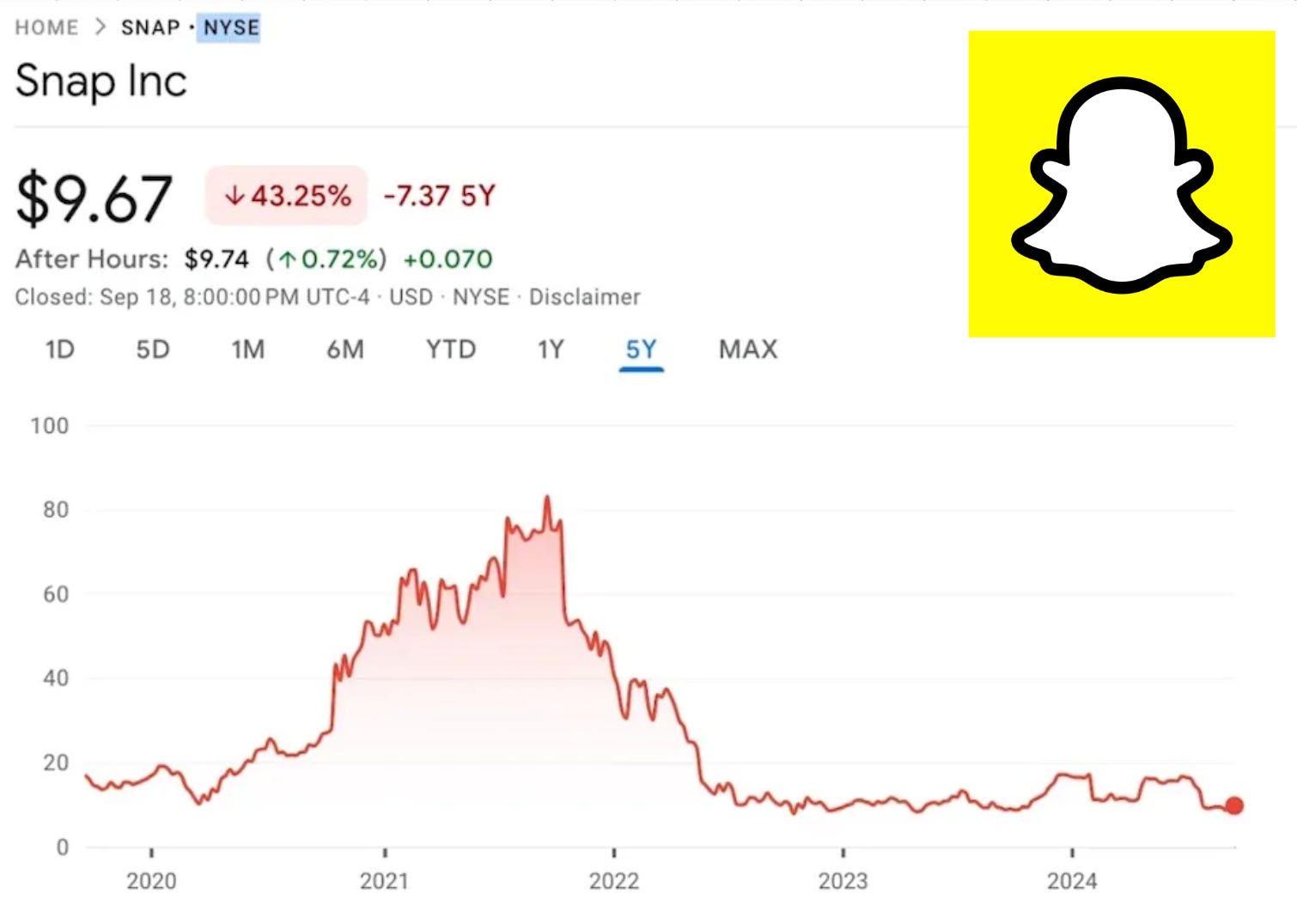
Disappearing messages. Stories. AR filters. Snapchat built all of it first. Then, one by one, it watched Meta, Apple and Google pick up each invention, bolt it onto a bigger audience, and turn it into a weapon against the company that dreamed it up. That’s not bad luck. That’s a brand strategy failure playing out in slow motion, and it’s worth sitting with, because the mistakes are the kind that show up in far smaller businesses too.
The company that refused to be a company
Snapchat’s origin story is already a tell. Three Stanford students, one stolen idea, and a founder in Evan Spiegel who paid the guy whose concept it originally was $157 million after a lawsuit rather than any credit up front. Before Snapchat had a single user, it had already established the pattern that would define it: take what works, don’t ask who it belongs to, and assume growth forgives everything.
That instinct served Spiegel well early on. When Mark Zuckerberg offered $3 billion to buy the company in 2013, Spiegel said no and bought six copies of The Art of War for his team. Ballsy, and in isolation, a defensible bet on his own vision. But it also revealed something about how he’d run the company for the next decade: alone, and unwilling to hear otherwise.
The camera company that couldn’t cash the cheque
Here’s the detail that matters most to me, because it’s a positioning decision, and positioning decisions are the ones that quietly determine everything downstream. When Snapchat filed to go public in 2017, it didn’t describe itself as a social network. It called itself a camera company.
That wasn’t modesty. It was counterpositioning, and for a while it worked brilliantly. Facebook was the incumbent that tracked you, catalogued you, and sold you to advertisers. Snapchat’s entire pitch was the opposite: nothing sticks, nothing gets remembered, nothing becomes a permanent record of your teenage years. For a generation of users who’d grown up watching their parents get in trouble for what they posted, that was a genuine category entry point. Real need, real moment, real reason to open the app.
But counterpositioning against a business model means you’ve also locked yourself out of that business model. Meta makes north of $200 per user per year in the US because it knows everything about you. Snapchat built its entire identity on knowing nothing about you, on purpose, as a feature. You cannot have it both ways. The thing that made Snapchat feel safe and different is the exact thing that capped how much money it could ever make from each user. That’s not an accident of execution. That’s what happens when your positioning is defined entirely in opposition to someone else, rather than around a need you can monetise on your own terms.
Assets versus moments
The second thing Snapchat never seemed to grasp is the difference between an audience and a moment. Every Snap disappeared. Every post was a fresh start. Which sounds poetic until you realise it means there was nothing to compound, nothing to build on, and nobody with a reason to keep showing up for you specifically rather than for the app in general.
Compare that to what Instagram did the second it cloned the Stories format in 2016. Instagram already understood that a following is an appreciating asset. Creators come back because the relationship compounds: post today, and people who liked yesterday’s post are there to see it. That reciprocity is the entire economic engine behind the creator economy, and it’s why people who make content for a living live on Instagram, YouTube and TikTok, not Snapchat.
Kylie Jenner’s tweet in February 2018 (does anybody else not use Snapchat anymore or is it just me?) wasn’t a random celebrity complaint. It was a rational response to a platform that had built nothing for her to invest in. On Snapchat, she got nothing back for the audience she’d built there. On Instagram, every follower was a compounding asset she could keep nurturing. The stock lost $1.3 billion in a day. That’s what it costs when a platform never gives its most valuable users a reason to stay other than habit.
Being first isn’t a moat
The most expensive lesson in this whole story is that invention without a network is just R&D for your competitors. Snapchat built disappearing messages before Apple made them a standard iMessage feature in 2017. It built AR filters before Instagram and everyone else made them table stakes. It built Stories before Instagram took the format and, within two months, had grown it to 100 million users, more than Snapchat itself had at the time.
None of that was theft in the legal sense. It’s just what happens when your invention is a feature rather than a system. Instagram wasn’t cloning a product, it was attaching a proven feature to something Snapchat never built: a durable social graph. That’s the pattern repeating again right now with AR glasses. Snapchat’s new Spectacles are, by all technical accounts, genuinely excellent, competitive with Apple’s Vision Pro. But Meta’s glasses come with the Facebook social graph already wired in, Google’s will come with Android and search, and Apple’s will come with an ecosystem people are already locked into. Snapchat has spectacular hardware and nobody to send a message to. First doesn’t mean forever if you never convert the invention into a relationship people can’t get anywhere else.
The dictator problem
Underneath all of it sits the same structural flaw: a founder who never had to listen to anyone. When Snapchat’s 2018 redesign tanked usage, lost three million users in a single quarter and triggered a 1.2 million-signature petition to reverse it, reports later confirmed that Spiegel had overruled his own team’s warnings. Nobody could stop him, because nobody was structurally able to.
That’s the through-line from the Reggie Brown lawsuit to the Zuckerberg standoff to the redesign disaster to the TikTok scramble that burned through $130 million in creator payments with nothing to show for it once the money stopped. Total control can produce fast, confident decisions. It can also produce catastrophically wrong ones with no mechanism to catch them before they ship. Every founder I respect is the opposite of this: hungry for the pushback, not immune to it.
Four things worth carrying forward
If I pull the thread on all of this, four ideas keep surfacing that apply well beyond Snapchat.
First, counterpositioning against a competitor’s business model is powerful for growth and dangerous for monetisation. It wins you an audience by being everything the incumbent isn’t, but it can permanently box you out of the revenue mechanics you’ll eventually need. Know which trade-off you’re making before you make it.
Second, an audience is an asset, a moment is not. If your product gives users no reason to compound a relationship, whether that’s followers, loyalty, or repeat use, you’re renting attention, not building a business. The people who matter most to your growth need a reason to stay that outlasts novelty.
Third, invention is not a moat. Being first to a feature only matters if you can convert it into a system, network, or relationship your competitors can’t copy. Otherwise you’re doing unpaid product research for whoever has the bigger distribution.
Fourth, a founder who can’t be challenged is a single point of failure for the entire business. Fast decisions made in isolation work right up until they’re catastrophically wrong, and there’s no one there to catch it before it costs you three million users in a quarter.
Snapchat isn’t a failure by any normal measure. Evan Spiegel is a billionaire and 450 million people still open the app daily. But it’s the story of a company that kept inventing the future and kept handing it to somebody else to own.
Behind the Brand is written by the team over at Defiant. We bring together big agency brains with Effie winning writers, comedians & creators with millions of followers. We help brands define razor-sharp strategy & develop creative ideas that win the war on attention.
Learn more about us HERE
Was this written by AI? :(
These feel like stock AI clause:
Not this, that format: "That’s not bad luck. That’s a brand strategy failure" "That wasn’t modesty. It was counterpositioning," "Snapchat isn’t a failure by any normal measure. But it’s the story of a"
Using 'quietly' to modify a strong verb: "quietly determine"
Something always has to "matter"
I remember someone caustically saying “Snap is the unofficial R&D dept for Facebook…” OUCH!